
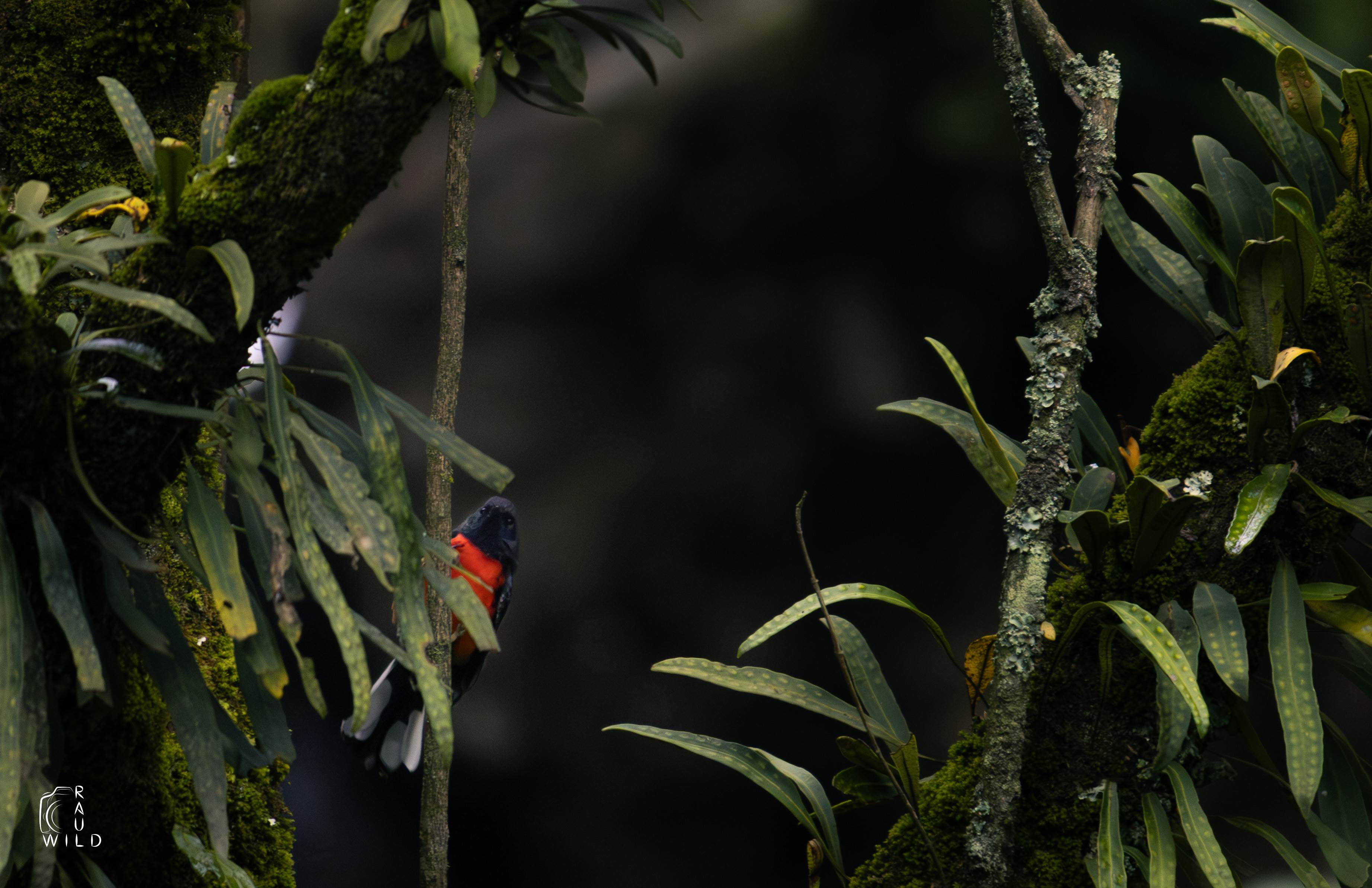
Deep within the ravines of Los Dinamos, where Mexico City quietly gives way to ancient forest, a sudden spark of red cuts through the green. For a split second, the understory comes alive, a Painted Redstart (Myioborus pictus), perched between moss covered trunks and epiphytic leaves, suspended in a cathedral of shadow and silence.
This photograph was not about speed or spectacle. It was about patience, terrain and learning to read the forest on its own terms.
Los Dinamos is one of the last strongholds of temperate forest within Mexico City’s limits. Fed by cold rivers and shaped by volcanic geology, its canyons host a mix of pine, oak and cloud forest species. This ecological transition zone is precisely what makes it a haven for birds like the Painted Redstart, species that rely on intact understory, insect abundance and complex vertical structure.
Standing here with a camera, it’s impossible not to feel the contrast: millions of people nearby, yet a forest still functioning as a living system.
The Painted Redstart is a small warbler, but its presence is anything but subtle. Its black head and back absorb light, while the vivid red breast and flanks seem to ignite when it moves. Behaviorally, it is known for wing flicking displays, flashing white patches to startle insects into flight, an elegant hunting strategy refined through evolution.
In this image, the bird is partially concealed, framed by trunks and bromeliads. That concealment is intentional, not accidental. It reflects how these birds live: rarely exposed, constantly weaving through layers of vegetation, masters of the in between spaces.
Forest photography is an exercise in restraint. Light is scarce, backgrounds are chaotic and subjects appear without warning.
For this frame, the technical challenge was clear:
- Low, directional light filtering through the canopy
- High contrast between the bird’s red plumage and the surrounding greens
- A narrow visual corridor, with branches constantly interfering with focus
Using a telephoto lens allowed me to compress the scene, isolating the bird without stripping it from its habitat. A wider aperture helped separate subject from background while preserving just enough detail to tell the ecological story. Autofocus hunted constantly, anticipation mattered more than reaction.
The photograph was taken not when the bird arrived, but when everything aligned for half a second of stillness.
This image is as much about habitat as it is about the bird. The moss covered trunks, epiphytic plants, and layered foliage are indicators of a healthy, moisture rich forest system. Painted Redstarts are sensitive to habitat degradation, their presence here signals ecological continuity.
Yet this balance is fragile. Urban expansion, water diversion and recreational pressure threaten areas like Los Dinamos. When forest corridors shrink, species that depend on microhabitats disappear quietly, often before anyone notices.
Photography becomes a form of record keeping. Proof that this place and this life, existed in this form.
Wildlife images don’t need drama to be powerful. Sometimes they work best when they ask the viewer to slow down, to search the frame, to notice color emerging from shadow, to recognize that nature often reveals itself subtly.
This Painted Redstart is not centered. It is not isolated against a clean background. It is exactly where it belongs: embedded in the forest that sustains it.
That, to me, is conservation photography, not removing the wild from its context, but honoring the complexity that keeps it alive.
Every visit to Los Dinamos reinforces the same lesson: wild spaces don’t need to be distant to be meaningful. They need attention, respect and protection. Carrying a camera into these forests is both a privilege and a responsibility, to tell stories that remind us what still survives, quietly, at the margins of the city.
This image is a small chapter in a much larger story, one written in feathers, moss, shadow and light.




Reportar comentario
¿Estás seguro de que quieres marcar este comentario para que lo revise un moderador?
Eliminar comentario
¿Estás seguro de que quieres eliminar tu comentario?
Adjuntar imagen
El tamaño de la fotografía excede el máximo permitido de {{comments.model.imageCommentMaxSize}}Mb
Hace {{c.notificationDate.seconds}} segundos
Hace {{c.notificationDate.mins}} minuto
Hace {{c.notificationDate.mins}} minutos
Hace {{c.notificationDate.hours}} hora
Hace {{c.notificationDate.hours}} horas
Hace {{c.notificationDate.days}} día
Hace {{c.notificationDate.days}} días
Hace {{c.notificationDate.weeks}} semana
Hace {{c.notificationDate.weeks}} semanas
Canon Creators
Hace {{replies.notificationDate.seconds}} segundos
Hace {{replies.notificationDate.mins}} minuto
Hace {{replies.notificationDate.mins}} minutos
Hace {{replies.notificationDate.hours}} hora
Hace {{replies.notificationDate.hours}} horas
Hace {{replies.notificationDate.days}} día
Hace {{replies.notificationDate.days}} días
Hace {{replies.notificationDate.weeks}} semana
Hace {{replies.notificationDate.weeks}} semanas
Canon Creators
Canon Creators
Este mensaje fue eliminado por el administrador
Canon Creators
Este mensaje fue eliminado por el administrador